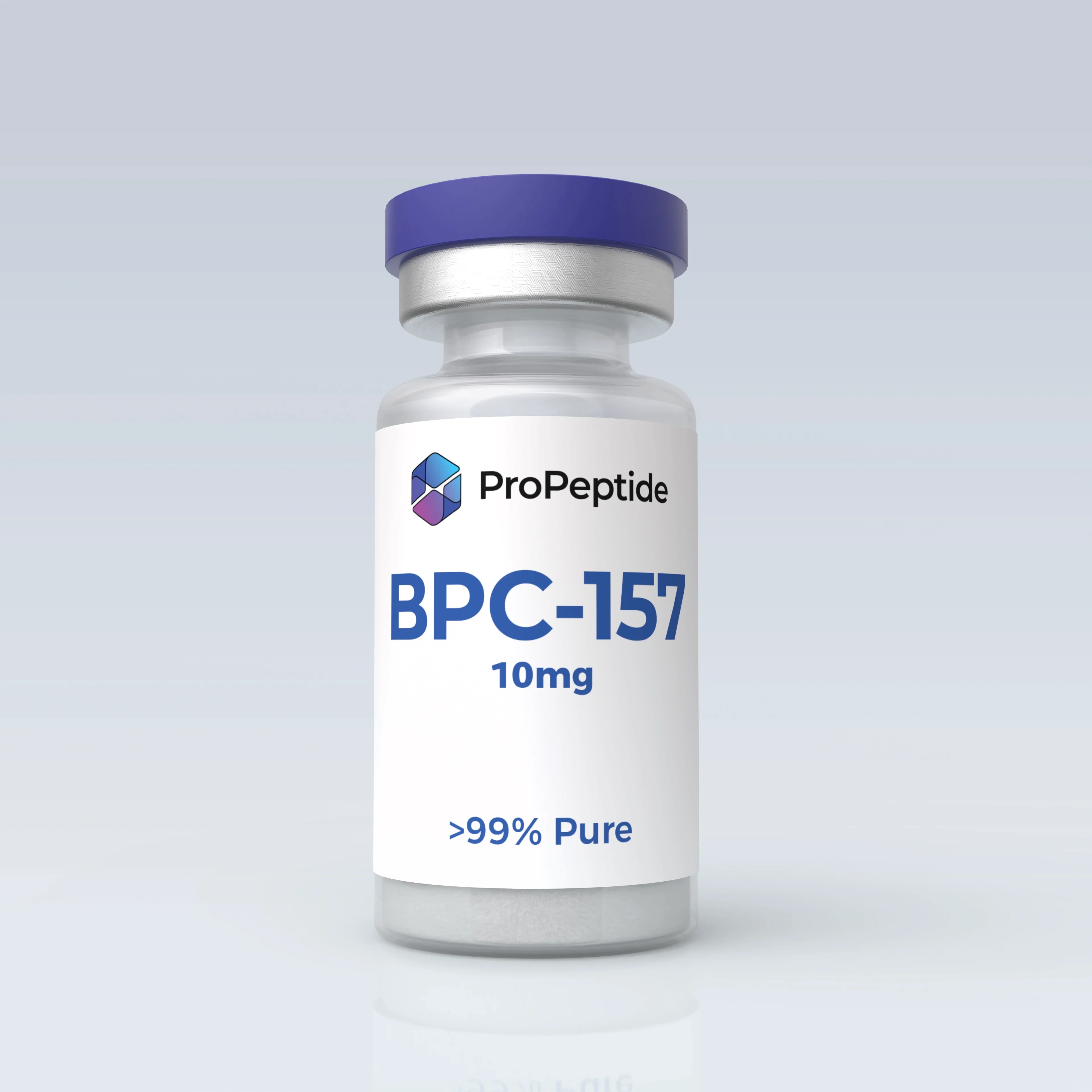
Buy the ProPeptide BPC-157 10mg vial in the UAE. BPC-157 (Body Protection Compound 157) is a synthetic 15 amino acid pentadecapeptide used in tendon, ligament, gut, joint, and post-injury research. Specified at ≥99% purity. Same-day Dubai delivery. Outside Dubai, Saturday orders are delivered on Monday. Delivery costs AED 50 below AED 1,000 and is free from AED 1,000.
- ≥99% Purity
- ProPeptide Brand Standard
- Same-Day Delivery
- Dubai
- Lyophilized Vial
- Research Format
- Storage Guidance
- Follow Package Label
- 1x ProPeptide research vial (lyophilized powder)
- Cold-chain insulated packaging
BPC-157 10mg Vial
In stock · UAE delivery: AED 50 below AED 1,000; free from AED 1,000
Specified ≥99% ProPeptide Brand Standard
- Unit
- AED 220 / vial
- Per mg
- AED 22
- Total
- AED 220
Ships from Dubai
What Is BPC-157?
BPC-157 (Body Protection Compound 157) is a synthetic 15 amino acid pentadecapeptide derived from a sequence found in a protective protein in human gastric juice. It was first isolated and characterised by Professor Predrag Sikiric's research team at the University of Zagreb in the 1990s, and has since become one of the most extensively studied repair peptides in the published literature. Over a hundred published studies cover its activity in tissue repair, gastrointestinal protection, angiogenesis, and related pathways. People use it for tendon and ligament healing, gut repair (including SIBO, IBS, and leaky gut protocols), joint recovery, and post-injury support. It is one of the most widely used peptides in the recovery and biohacking community.
BPC-157 is most often injected subcutaneously near the area of injury or systemically into the abdomen, and many people also use it orally for gut-focused protocols (it is reported to be stable in stomach acid, which is unusual for a peptide). Common protocols run daily for 4–6 weeks at 250–500 mcg per day, then a break before the next cycle. The peptide has a short half-life, which is why daily dosing is the standard pattern.
What it actually does in the body has been studied for over two decades. Published animal-model research has reported accelerated tendon-to-bone healing, faster repair of ligaments and muscle tears, restoration of stomach and intestinal lining after damage, and improved blood vessel growth (angiogenesis) at injury sites. Most of the human evidence is anecdotal but consistent: recovery athletes, post-surgical patients, and people managing chronic gut issues are the largest user groups.
ProPeptide supplies BPC-157 as a lyophilized 10mg vial that you reconstitute with bacteriostatic water using sterile technique. Product specifications and batch documentation are kept product-specific and current. The product is not a licensed medicine and is sold as a research peptide.
Why Buy BPC-157 10mg from ProPeptide?
Product-specific documentation.
Specifications and documentation are kept product-specific and current.
Sealed lyophilized vial.
Each 10mg vial is lyophilized in a controlled environment and sealed with a crimp cap. You reconstitute with bacteriostatic water using sterile technique. Most people use 2mL for a 5mg/mL stock that maps cleanly to whole insulin units (5 units = 250 mcg, 10 units = 500 mcg).
Cold-chain, same-day Dubai delivery, UAE-wide.
Orders placed before 4 PM ship the same day inside Dubai. Outside Dubai, order before 12 PM (noon) for next-day delivery to all six other emirates. Orders placed on Saturday will be delivered on Monday, and Sunday delivery is not available outside Dubai. Delivery costs AED 50 below AED 1,000 and is free from AED 1,000. Cold-chain insulated packaging keeps the vial in the +2 to +8°C range from our facility to your door, with ice packs for any leg of the trip that needs them.
Direct from ProPeptide.
Sourced and packed in our own facility. Not relabelled from a middleman. No clinic markups, no distributor margins, no mystery supply chains. We are adding batch-number printing directly to ProPeptide packaging; if you need a box-printed batch number with a matching published COA today, choose the Remedium Research Retatrutide product.
Stack-ready with TB-500.
BPC-157 is most often paired with TB-500 in recovery protocols. The two target overlapping but distinct repair pathways. We stock TB-500 separately as a 10mg vial and as a fixed 5mg + 5mg BPC-157 / TB-500 blend vial for people who prefer one reconstitution instead of two.
We answer questions, not orders.
We do not give medical advice, but we are happy to walk you through how the product works and what to expect when you receive it.
Technical Specifications
| Manufacturer | ProPeptide |
|---|---|
| Compound | BPC-157 (Body Protection Compound 157) |
| CAS Number | 137525-51-0 |
| Quantity | 10mg per vial |
| Format | Lyophilized powder, sealed glass vial |
| Purity | Specified ≥99% |
| Molecular Weight | 1,419.5 Da |
| Sequence | Gly-Glu-Pro-Pro-Pro-Gly-Lys-Pro-Ala-Asp-Asp-Ala-Gly-Leu-Val (15 amino acids) |
| Half-life | Short (minutes in plasma); local tissue effects reported to outlast plasma presence |
| Stability | Unusually stable in gastric acid. Unique among peptides, which is why oral dosing is viable for gut-focused protocols |
| Routes commonly used | Subcutaneous (most common), intramuscular near injury site, oral for gut-focused protocols |
| Storage | +2 to +8°C lyophilized. Reconstituted: +2 to +8°C, protect from light, do not freeze. |
| Shelf Life | 24 months from manufacture, lyophilized and sealed |
How BPC-157 Works: The Repair Pathways
BPC-157 is one of the most-studied repair peptides in the published literature. The published mechanism work is largely from animal-model research, but it is consistent across a long list of independent groups. Three pathways come up repeatedly:
Angiogenesis (new blood vessel growth)
BPC-157 is reported to upregulate vascular endothelial growth factor receptor 2 (VEGFR2) and to drive new capillary growth at injury sites. New blood vessels mean more oxygen and nutrients delivered to damaged tissue, which is why repair work (tendons, ligaments, gut lining) is faster in animal models that received BPC-157.
Nitric oxide (NO) signalling
BPC-157 interacts with the nitric oxide pathway, which controls blood vessel dilation, blood flow to tissues, and the body's general response to injury. Better local blood flow at an injury site is one of the reported reasons people see faster recovery from soft-tissue injuries when they use it.
Growth factor and tendon-cell signalling
Animal-model studies have reported BPC-157 increasing the expression of growth hormone receptors on tendon fibroblasts, accelerating fibroblast proliferation and collagen organisation, and restoring tendon-to-bone healing after surgical transection. This is the mechanism most commonly cited by people using it for tendon and ligament work.
Gut-lining protection
BPC-157 is named for its protective effect on the stomach and intestinal lining. Animal-model research has reported it accelerating healing of stress ulcers, NSAID-induced gut damage, and inflammatory bowel lesions. This is the basis for the gut-repair protocols people use it in (often orally, since it is reported to survive stomach acid).
Neuroprotective signalling
Animal-model research has reported BPC-157 interacting with the dopaminergic and serotonergic systems, with reported effects in brain-injury, stress, and neuroprotection models. This is a less common but well-represented thread in the published BPC-157 research, and shows up in some longer-cycle community protocols.
BPC-157 vs TB-500: How They Compare
BPC-157 and TB-500 are the two most common repair peptides, and they are often stacked because they target different but complementary parts of the healing process. Here is how they line up:
| BPC-157 | TB-500 | |
|---|---|---|
| Origin | 15 aa fragment of a protein found in human gastric juice | Synthetic version of the active region of thymosin β-4 |
| Primary use cases | Tendon and ligament healing, gut repair, joint recovery, post-injury support | Soft-tissue and muscle repair, recovery from injury, vascular healing, hair and skin protocols |
| Common dose | 250–500 mcg/day, often near the injury site | 2–2.5mg twice weekly, usually subcutaneous |
| Cycle length | 4–6 weeks daily, then break | 4–6 weeks at loading dose, then a maintenance phase |
| Routes used | Subcutaneous, IM near injury, oral for gut protocols | Subcutaneous, IM near injury |
| Half-life | Short, daily dosing | Long, twice-weekly dosing is enough |
| Format (at ProPeptide) | 10mg vial (AED 190) | 10mg vial (AED 190) |
| Often stacked with | TB-500 (5+5 blend vial available) | BPC-157 (5+5 blend vial available) |
Most people running a recovery protocol use both. BPC-157 covers angiogenesis and gut-lining work; TB-500 covers actin remodelling and large-scale tissue repair. The 5mg + 5mg BPC-157 / TB-500 blend vial is the easier option if you want one reconstitution instead of two.
Dosing & Reconstitution Reference
Reconstitute the 10mg vial with bacteriostatic water using sterile technique. 2mL is the most common choice. It gives a 5mg/mL stock that maps cleanly to whole insulin units on a U-100 syringe (5 units = 250 mcg, 10 units = 500 mcg, 20 units = 1mg). 1mL gives a stronger 10mg/mL stock that is useful for larger draws but less precise for small ones. Most people use 2mL.
| Stage | Amount | Purpose |
|---|---|---|
| Reconstitution | 2mL bacteriostatic water + 10mg vial | Yields a 5mg/mL stock (5 units = 250 mcg) |
| Common starting dose | 250 mcg / day | 5 units on a 5mg/mL stock; typical for week 1 |
| Common maintenance dose | 500 mcg / day | 10 units on a 5mg/mL stock; most common protocol dose |
| Local injury site | 250–500 mcg into the area near the injury | Tendon, ligament, joint protocols typically inject local rather than systemic |
| Oral / gut-focused | 250–500 mcg orally daily | Gut protocols (SIBO, IBS, leaky gut) often use oral dosing |
| Cycle length | Daily for 4–6 weeks, then break | Standard cycle length; most people repeat with a break in between |
Dosing ranges above reflect commonly cited community and published protocols. They are reference points, not medical advice. ProPeptide does not provide medical advice. Speak with a qualified healthcare professional before starting any protocol.
To try other water volumes or vial strengths, use the reconstitution calculator.
For research purposes only. Not for human consumption.
Frequently Asked Questions
Where can I buy BPC-157 in Dubai or the UAE?
ProPeptide ships the BPC-157 10mg vial directly from Dubai. Same-day delivery is available on orders placed before 4 PM in Dubai. Outside Dubai, Saturday orders are delivered on Monday. Delivery costs AED 50 below AED 1,000 and is free from AED 1,000. The vial ships in cold-chain packaging.
Do you ship BPC-157 across the UAE?
Yes. We ship to all seven emirates with cold-chain packaging. Same-day Dubai delivery is available on orders placed before 4 PM. Outside Dubai, Saturday orders are delivered on Monday. Delivery costs AED 50 below AED 1,000 and is free from AED 1,000. Orders are insulated for the full UAE summer temperature range.
What is BPC-157 derived from?
BPC-157 is a synthetic 15 amino acid pentadecapeptide derived from a sequence found in a protective protein in human gastric juice. The 'BPC' in the name stands for Body Protection Compound. It was first isolated and characterised by Professor Predrag Sikiric's team at the University of Zagreb in the 1990s, and the synthetic form is what is sold as a research peptide today. It is unusually stable in stomach acid for a peptide, which is why oral dosing is viable for gut-focused protocols.
What do people use BPC-157 for?
The most common use cases are tendon and ligament healing, joint and connective tissue recovery, gut repair (SIBO, IBS, leaky gut, NSAID damage), and post-injury or post-surgical recovery. Athletes use it for soft-tissue injuries; people with chronic gut issues often use it orally; post-surgical users add it to their recovery routine.
How do you inject BPC-157?
Most people inject subcutaneously into the abdomen using a U-100 insulin syringe. For tendon, ligament, or joint work, many people inject locally near the affected area. For gut-focused protocols (SIBO, IBS, leaky gut), oral dosing is common. BPC-157 is reported to be stable in stomach acid, which is unusual for a peptide. Reconstitute with bacteriostatic water; 2mL gives a 5mg/mL stock where 5 units on the syringe equals 250 mcg.
What's the typical BPC-157 protocol?
The most common protocol is 250–500 mcg per day for 4–6 weeks, then a break before the next cycle. People starting out usually run 250 mcg/day for the first week and increase to 500 mcg/day after. Tendon and joint work tends to favour local injection near the site; systemic protocols (gut, general recovery) tend to use abdominal subcutaneous injection.
Can I stack BPC-157 with TB-500?
Yes. This is the most common repair stack. BPC-157 covers angiogenesis and gut-lining work; TB-500 covers actin remodelling and large-scale tissue repair. We stock TB-500 separately and as a fixed 5mg + 5mg BPC-157 / TB-500 blend vial that gives you one reconstitution instead of two.
How much does BPC-157 cost at ProPeptide?
A single 10mg BPC-157 vial is AED 190. The 5mg + 5mg BPC-157 / TB-500 blend vial is AED 400. BAC water is not included free; add it separately at checkout if you need it for your vials.
How should I store BPC-157?
Lyophilized vial: +2 to +8°C (standard refrigerator). Once reconstituted with bacteriostatic water: keep refrigerated, protect from light, do not freeze. Most people use a reconstituted vial within 4–6 weeks. The vial ships in cold-chain insulated packaging and should be refrigerated as soon as it arrives.